

Years of staring longingly at pictures and models of Angkor Wat, months of research, weeks of planning and finally the day arrived – the day we were actually going to see Angkor Wat!
To be honest, Angkor Wat is just one among the dozen or more fantastic temples and monasteries found in the Angkor region. But it was Angkor Wat that lured tourists from far and near. It is the symbol on the flag of Cambodia. It is the largest hindu temple in the world and I heard no camera has been able to capture the entire breadth of this humongous temple.
It remained virtually unknown to the world until the 21st century when its photographs were published to the western world and the entire Angkor region became a UNESCO heritage sight. And that’s when tourists started trickling and then flocking in to see this majestic sight. Today, it remains the most identifiable sight in the world.
Many countries, including France (largest presence), Japan and India, have been involved in clearing and restoring the temples. With the unrest during Khmer Rouge work on these temples were temporarily stopped before being resumed. Post Khmer Rouge there was also the job of clearing land mines. Thankfully, all the tourist frequented spots are land mine free today.
After reaching late the previous night by China Eastern Airlines through Shanghai, our 2 hour ahead body clocks woke us all up as early as 6 AM. We were out to have breakfast by 7:30 and were picked up by our tuk-tuk driver at 8:30 (considered late by Cambodian standards as most of them were already at the temples by 7:30). Our first stop was the ticket office to purchase our 3-day Angkor Pass. A few minutes of wait, our pictures taken and we were out holding our 3 day pass!
I had heard about how humid and hot the weather was but we soon discovered that riding the tuk-tuk we actually felt cool in the breeze.
Srah Srang

Our first proper sight-seeing stop was Srah Srang – the Royal Bath. An expansive stretch of water (not the most expansive, however), with a terrace built using sandstone and laterite between the 12th-13th centuries. Though the spot was famous for sunrise, it still looked serene and peaceful in the nearly mid-day sun. The terrace was flanked by nagas and lions. As with all steps in Angkor, they were quite steep.
Banteay Kdei

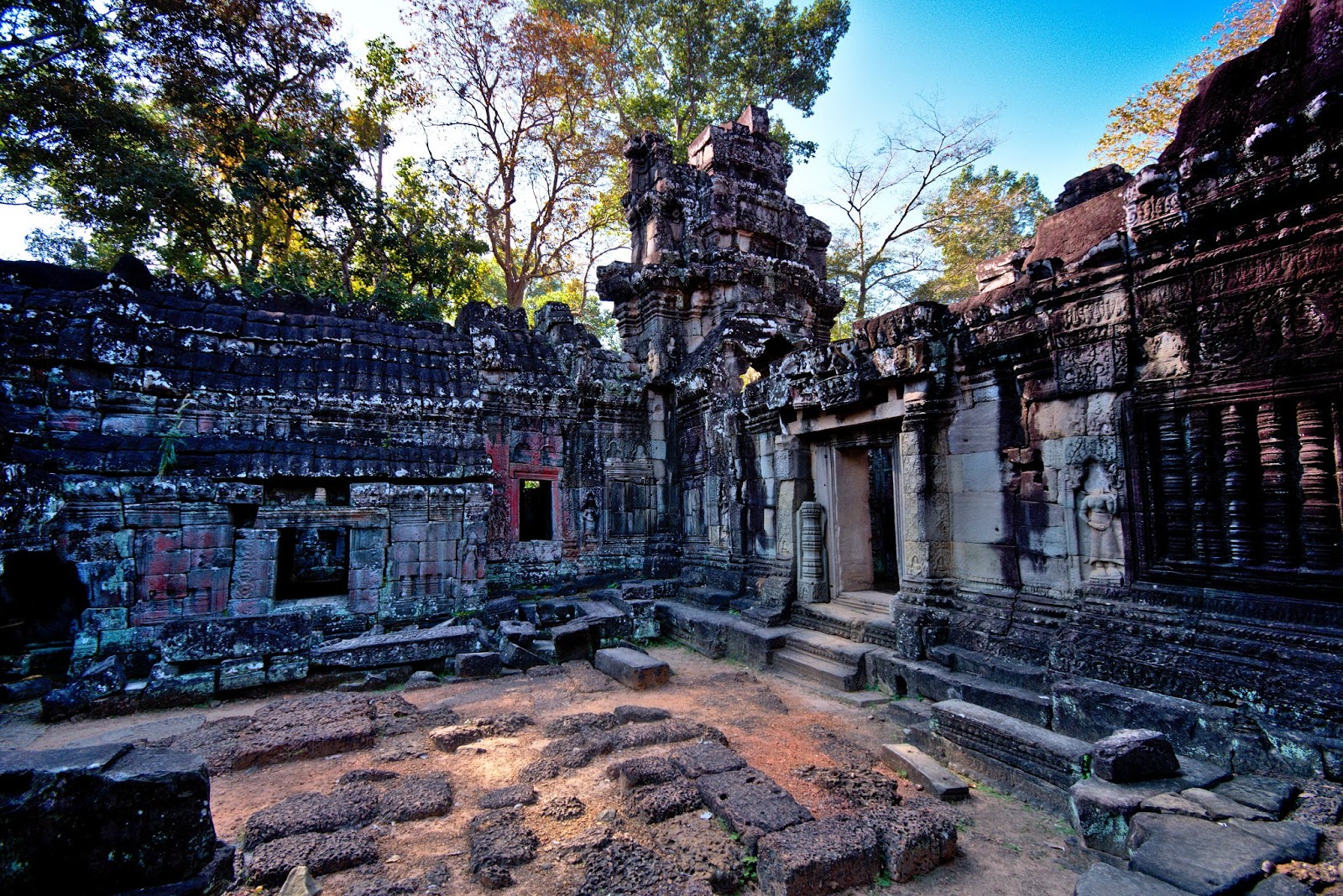
We then walked across from Srah Srang to Banteay Kdei’s east entrance, which was also built around the same time. Though I’ve read about how big it was, I was taken in by it’s size. After a long walk from the east facing gopura with it’s face of the Lokeshvara, we arrived at a nearly deserted temple. Walking across the terrace bordered by naga balustrades, we entered the roof less temple and gaped in awe at the layout, the courtyards and the beautiful carvings of apsaras among others on the walls. There was a huge silk cotton tree at the western end of the temple facing a pond. Though there were a few headless Buddhas, no one was quite sure to whom this temple was dedicated.
 |
|
The east Gopura with the face of Lokeshwara |
 |
|
An inner courtyard at Banteay Kdei |
 |
|
The silk cotton tree at the western face of the temple |
 |
|
Some of the amazing carvings and statues at Banteay Kdei |
We then met our tuk tuk driver at the western entrance and rode it to our next stop.
Thommanon and Chao Say Tevoda
 |
|
Chao Say Tevoda |
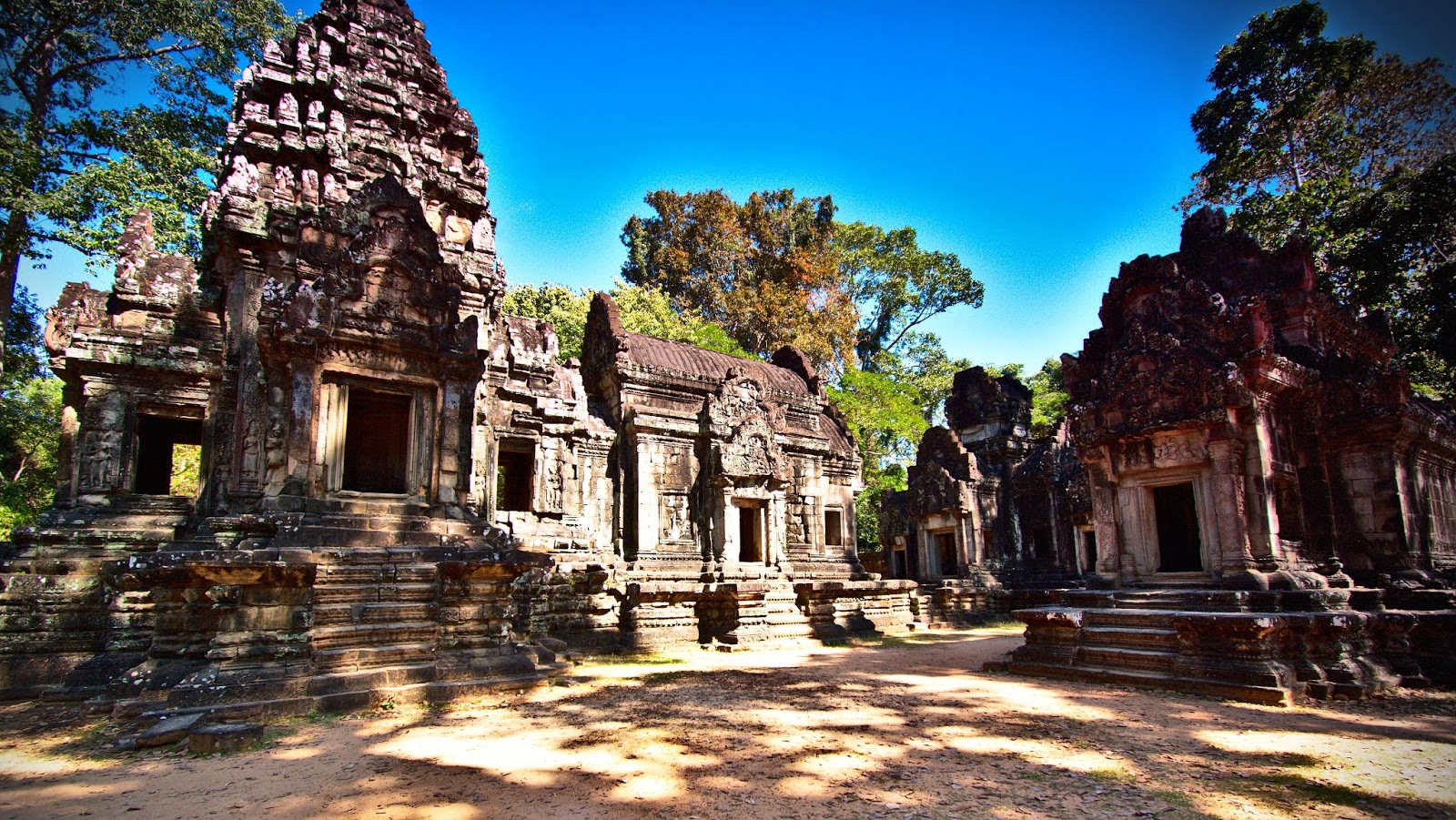
Two very compact temples on either side of the road both were similar and built in the 11th-12th centuries. It was nice to get a picture of a complete temple in one shot. This was also nearly deserted and had perhaps a handful of tourists until a tour bus arrived after which we left in haste!
There were lot of trees and most of Thommanon was in the shade. So we allowed ourselves a short break and sat ourselves on the remains of the laterite wall and stared at the small but stunning temple.
 |
|
Thommanon |
After crossing the road we spent quite a bit of time at Chao Say Tevoda, exploring the different sanctuaries. It seemed slightly different from Thommanon with a neat causeway leading to the eastern sanctuary. There was shade in front of the temple but not otherwise and it was getting very hot. While waiting for some tourists to finish taking their pictures I put my copy of the Ancient Angkor book on the causeway, only to forget it and leave it behind.
Angkor Thom
Most of what we know today about Angkor and the life back then are through the accounts of a Chinese traveler, Zhou Daguan, who visited and stayed in Angkor Thom in the late 13th century.
Angkor Thom was an ultra large city by his accounts. It had over 1 million people living in it at its peak. It had 5 gates and encompasses an area of roughly 900 hectares covered by 4 walls of 3 kms each in the four directions. It houses impressive ruins, the most popular of which is the Bayon.
 |
|
Victory Entrance at Angkor Thom |
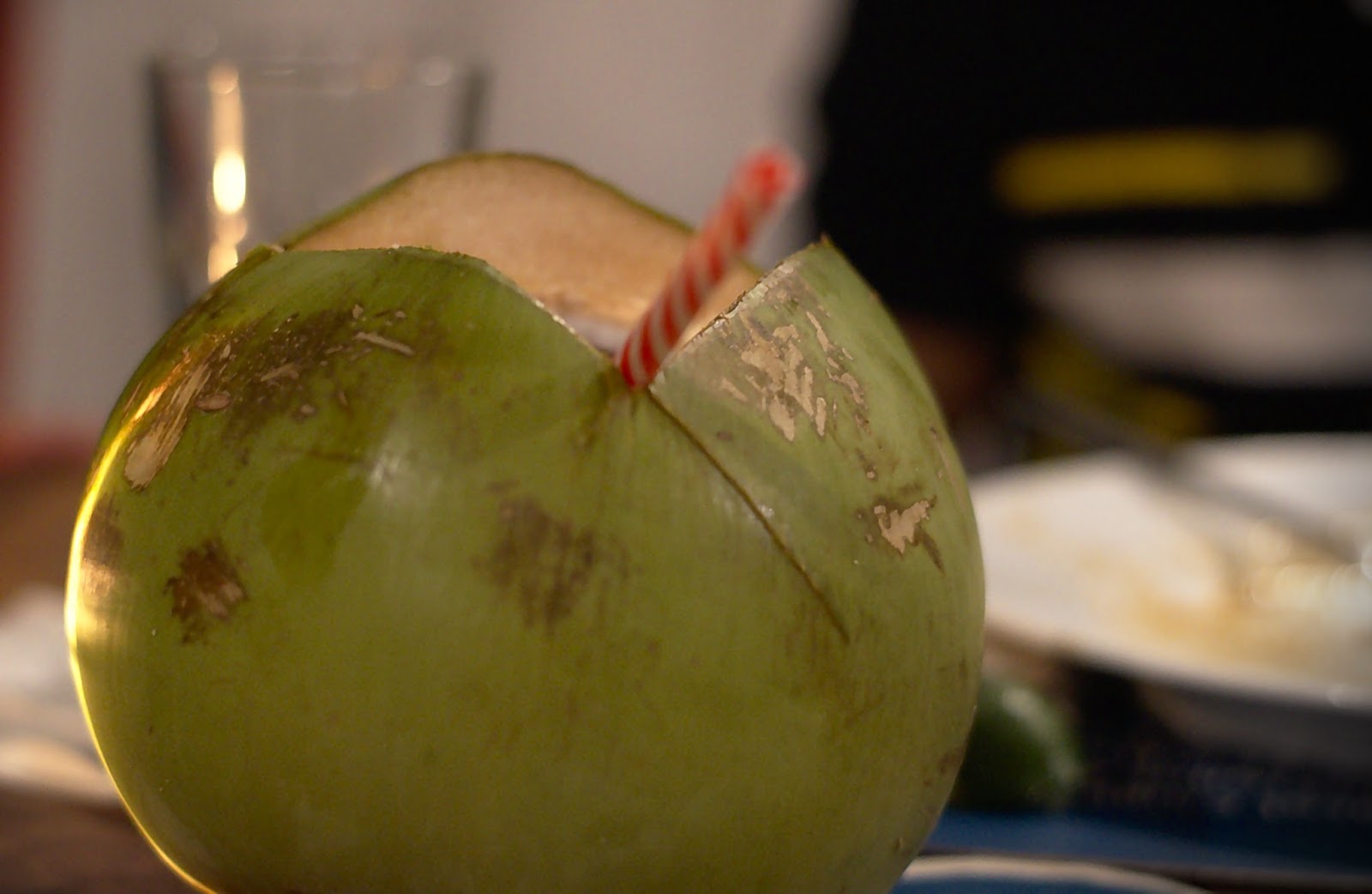
We were hot and tired by this time and we decided to break for lunch. Our tuk tuk driver took us through the victory gate of Angkor Thom to a large eatery across the Elephant terrace, perhaps catered to by different kitchens. We were seated under some fans and quickly ordered two very large refreshing coconuts! They were humongous and even after sharing it among four of us we struggled to finish it. The Amok was of average quality. After our restroom breaks and some shopping (who can avoid it when it’s right across!), we were on our way to visit the terraces during the hottest part of the day!
 |
|
Souvenir shop right across the eatery |
 |
|
Good place to buy some elephant pants for $2 |
Terrace of the Elephants and Leper King
 |
|
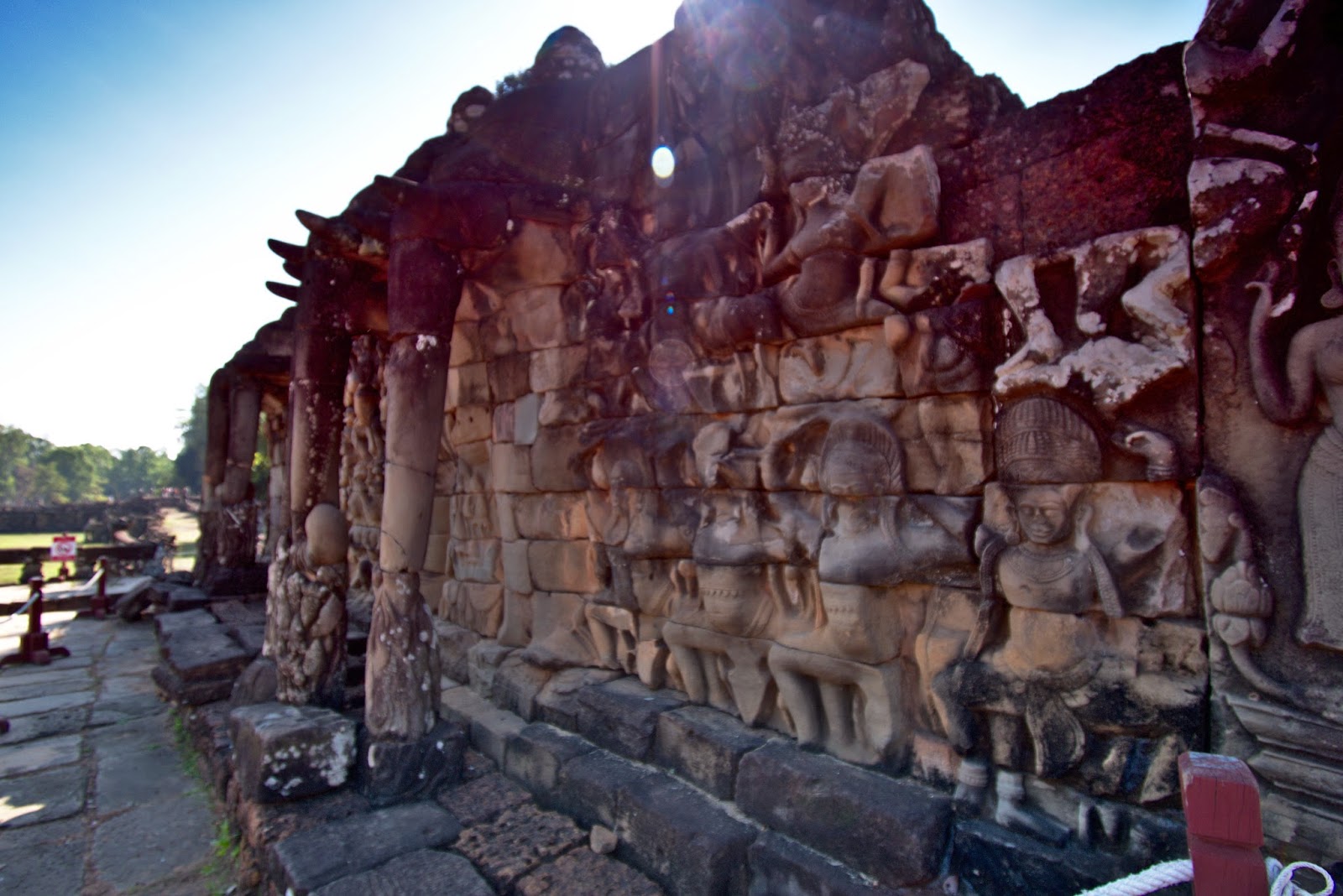
Terrace of the Elephants |
Arriving here in the mid-day sun, we weren’t too thrilled with the carvings here. We walked in the shade between the terraces and soon wanted to move on.The terraces are believed to receive victorious armies through the Victory Gate of Angkor Thom.
We passed by some more ruins on our walk to the Bayon which we had no clue what they were as we had lost our prized possession – Ancient Angkor. Our tuk tuk driver wasn’t too forthcoming about making the trip back to Chao Say Tevoda and dissuaded us saying it’d have been taken by someone else. A brand new book.. perhaps resold to unsuspecting tourists.
Bayon
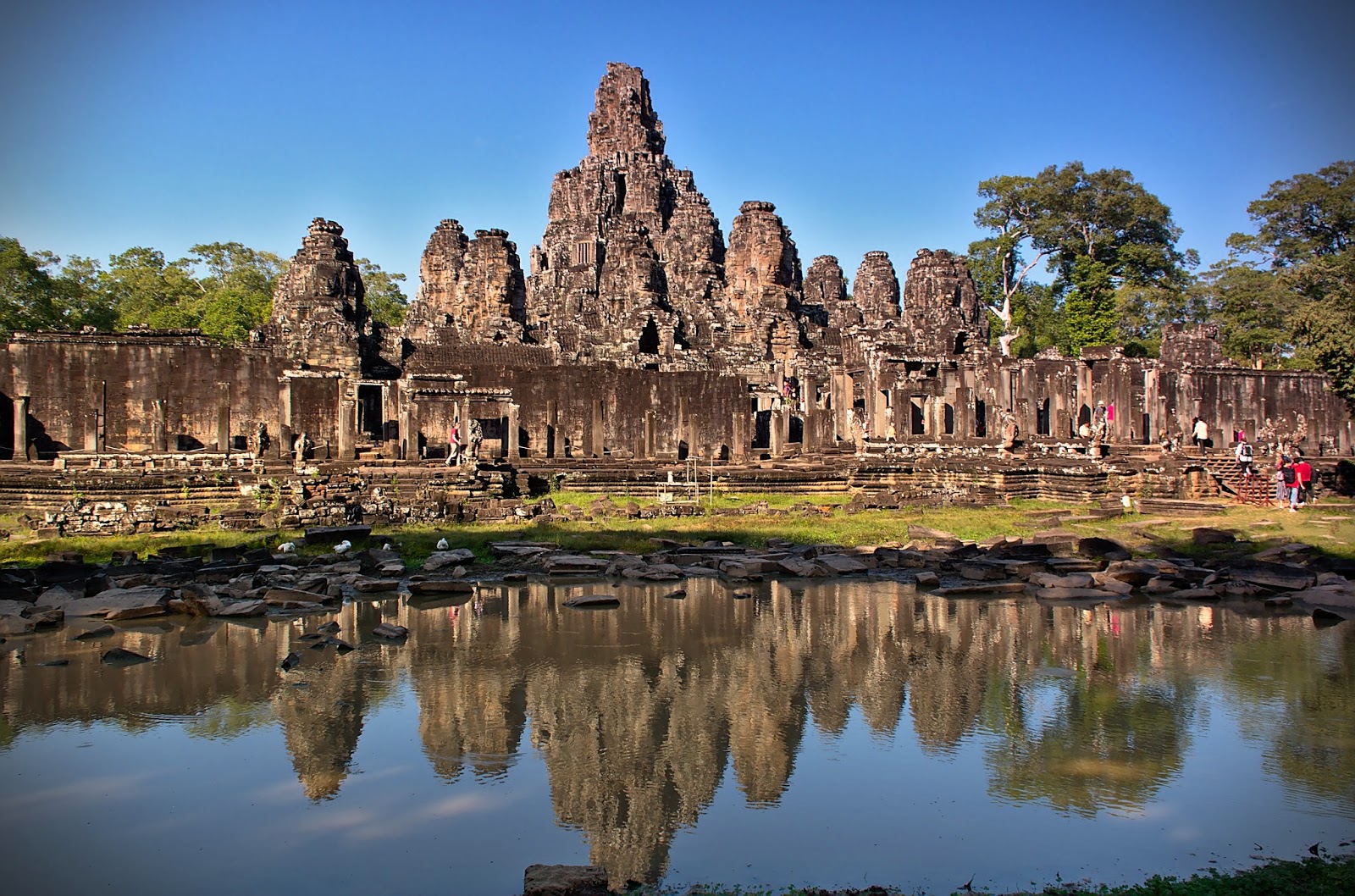
Built between the 12th-13th centuries by Jayavarman, Bayon was over run by the jungle when it was rediscovered in the early 20th century. The trees that had grown out of the temple had to be cleared to ensure the temple remained standing. It is believed that the temple was built over a period of time with many chambers and sanctuaries added much later on.
 |
|
Bayon from the reflecting pool on the south |
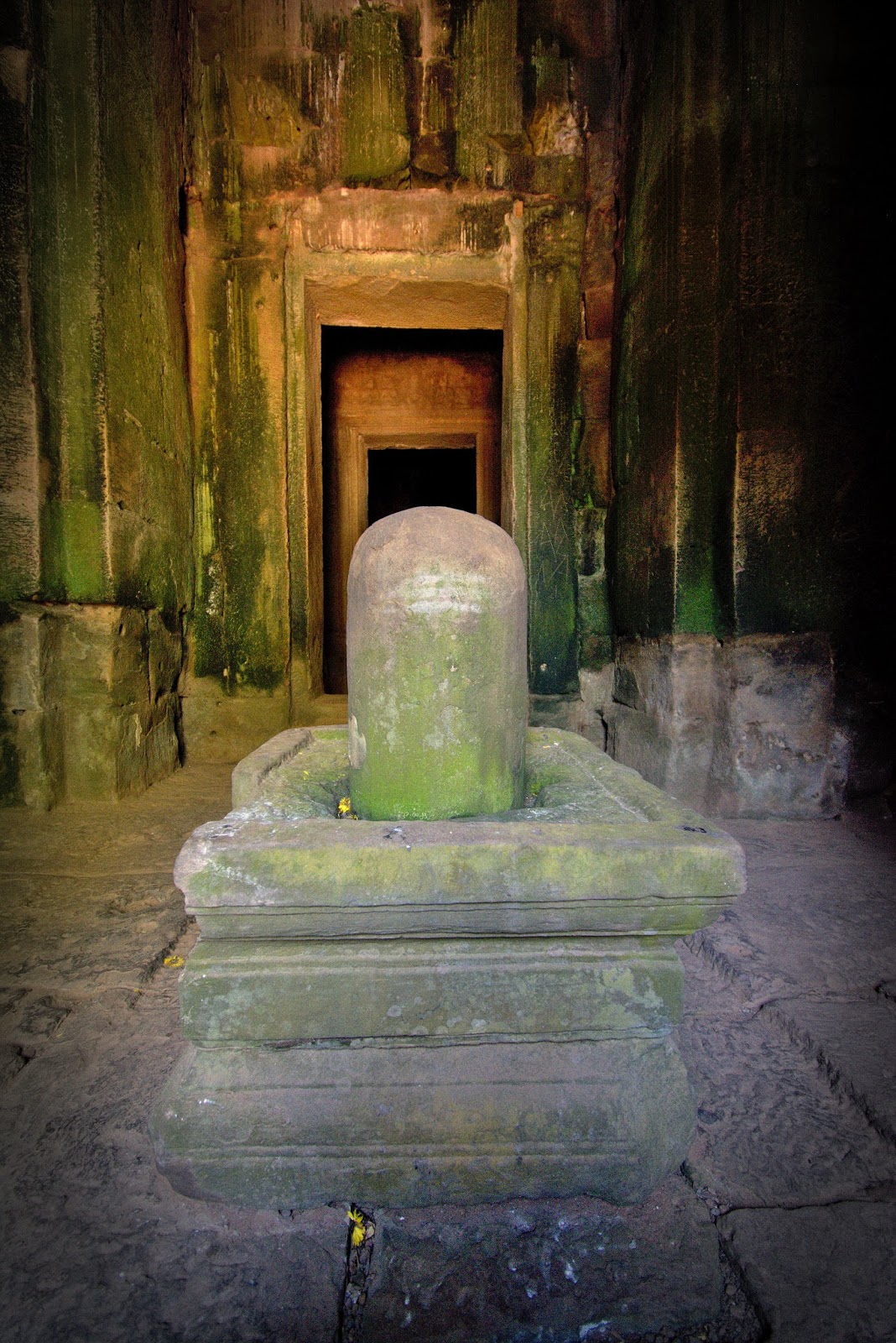
We made our way across to the northern entrance of one of the most popular and photographed monuments in the Angkor region. As we approached the entrance all we could see was a muddle of grey stones. Climbing up some steep stairs, we soon found ourselves looking at some wooden stairs that were leading up to the terrace but with a “no entry” sign. So we walked around to the east of the temple crossing chamber after chamber where we found a lone Shiva Linga.
 |
|
Doorways of the chambers inside Bayon |
 |
|
A lone Shiva Linga in one of the east facing chambers |
We soon found the way to head up to the terrace and we gladly raced up stairs to look at the faces of Avalokitesvara. 200 of them, smiling down benignly at the tourists who crane their necks to take in the majestic sight.

We let our imaginations drift.. perhaps these heads would be sharing stories from the day long after the tourists were gone a la “Night at The Museum”? Sharing funny incidents, perhaps a joke about the silly, insignificant tourists?
We spent quite a lot of time on the terrace in spite of the heat. There was some shade available and we sat ourselves to people watch and that included the faces of Avalokitesvara!
We then took the western stairway down only to be mobbed by an arriving Asian tour group. The stairs had no railing and was quite steep and I was afraid of being knocked over by the eager tourists. I sat down right on the stairs to let them pass before heading back down for a bottle of refreshing cold water in the tuk -tuk.
 |
|
Devas churning the milk ocean near the south gate of Angkor Thom |
We then took the south gate with the Devas and Asuras churning the milk ocean to the grand finale of the day’s touring – The Angkor Wat!
Angkor Wat
Nothing really prepares you for the sight of this majestic temple. H-U-M-O-N-G-O-U-S !! Built in the first half of the 12th century by Jayavarman, it was intentionally built facing west. Due to this many believe it to be a funerary temple. The temple measures 1.5km x 1.3km and is supposed to have contained a city in addition to the temple. The moat, the tiered temple galleries and the quincunx of towers were supposed to signify the mythical Mount Meru of Hinduism, the centre of the Universe.
 |
|
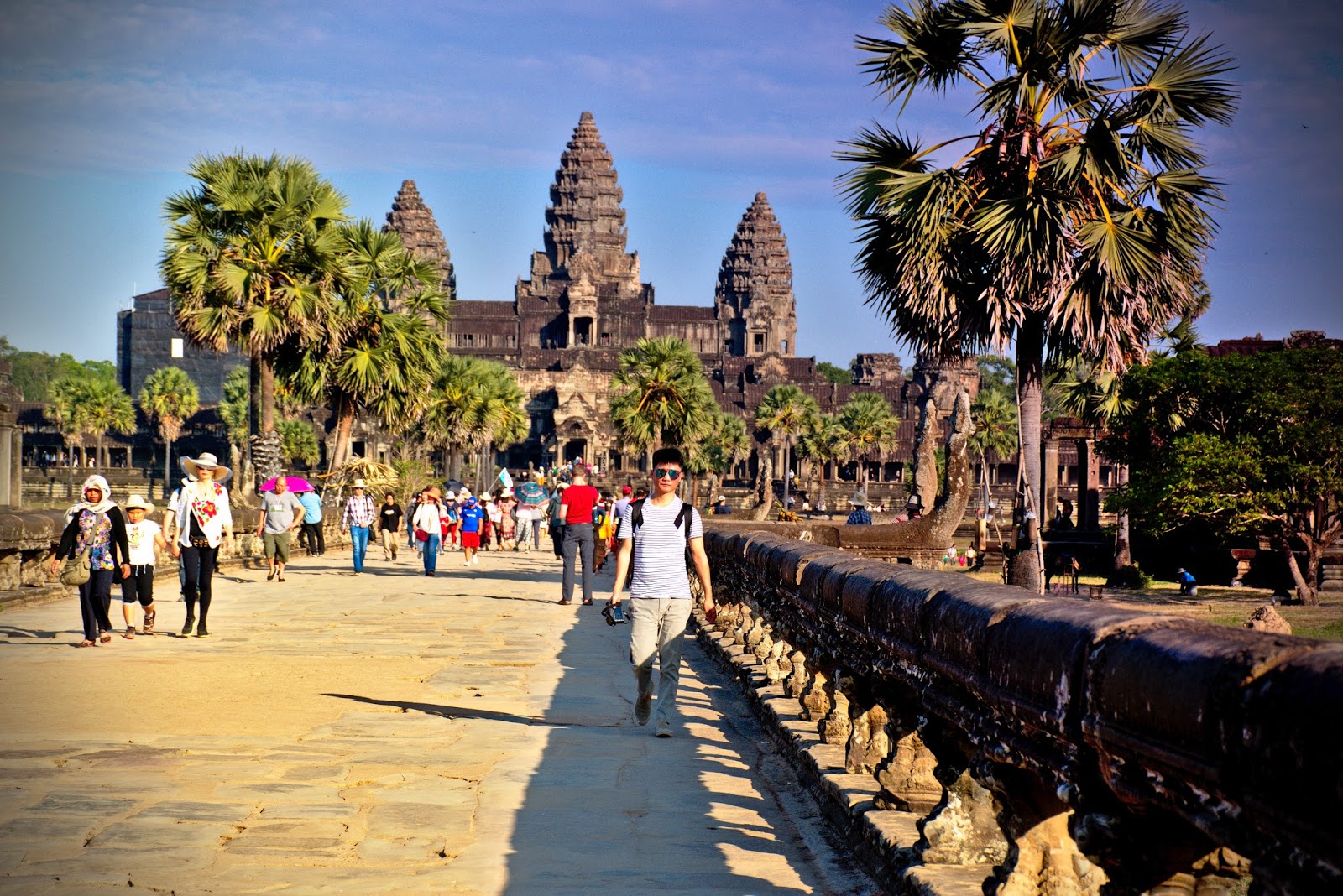
Angkor Wat from the floating bridge |
Angkor Wat was largely well preserved in comparison to other temples as many Khmer people continued to inhabit its premises and the super large moat also helped in keeping the jungle growth away.
The original causeway was under restoration so we made our way over the moat on a floating bridge. Needless to say, the moat is huge. It can pass off for a river!
 |
|
The statue of Lord Vishnu in the outer gallery, which is earlier believed to have been in the Sanctum-Santorium |
We entered the outer gallery on the far south and walked across to see the idol of Lord Vishnu, perceived to be the originally inside the central sanctum of this majestic temple. The person whom this temple was built for, before being moved away when the country and it’s people embraced Buddhism.
 |
|
Everyone wants a picture here! |
We then made our way to the most crowded spot – the pond on the left with a reflection of the five towers of Angkor. When we set up our tripod, some kind guides offered us some suggestions on the angle and pointed out how to get the five towers and their reflections. So we clicked a zillion pics before we moved on back to the causeway and to the main temple.
 |
|
The access to the main temple was from the cruciform terrace which was elevated a few steps from the causeway. On entering the temple, the entrance was flanked by a cloister that had 2 pools on either side. Bang in the middle of the cloister the compass on an iPhone displayed 0 degrees exactly – the centre of the universe, indeed!
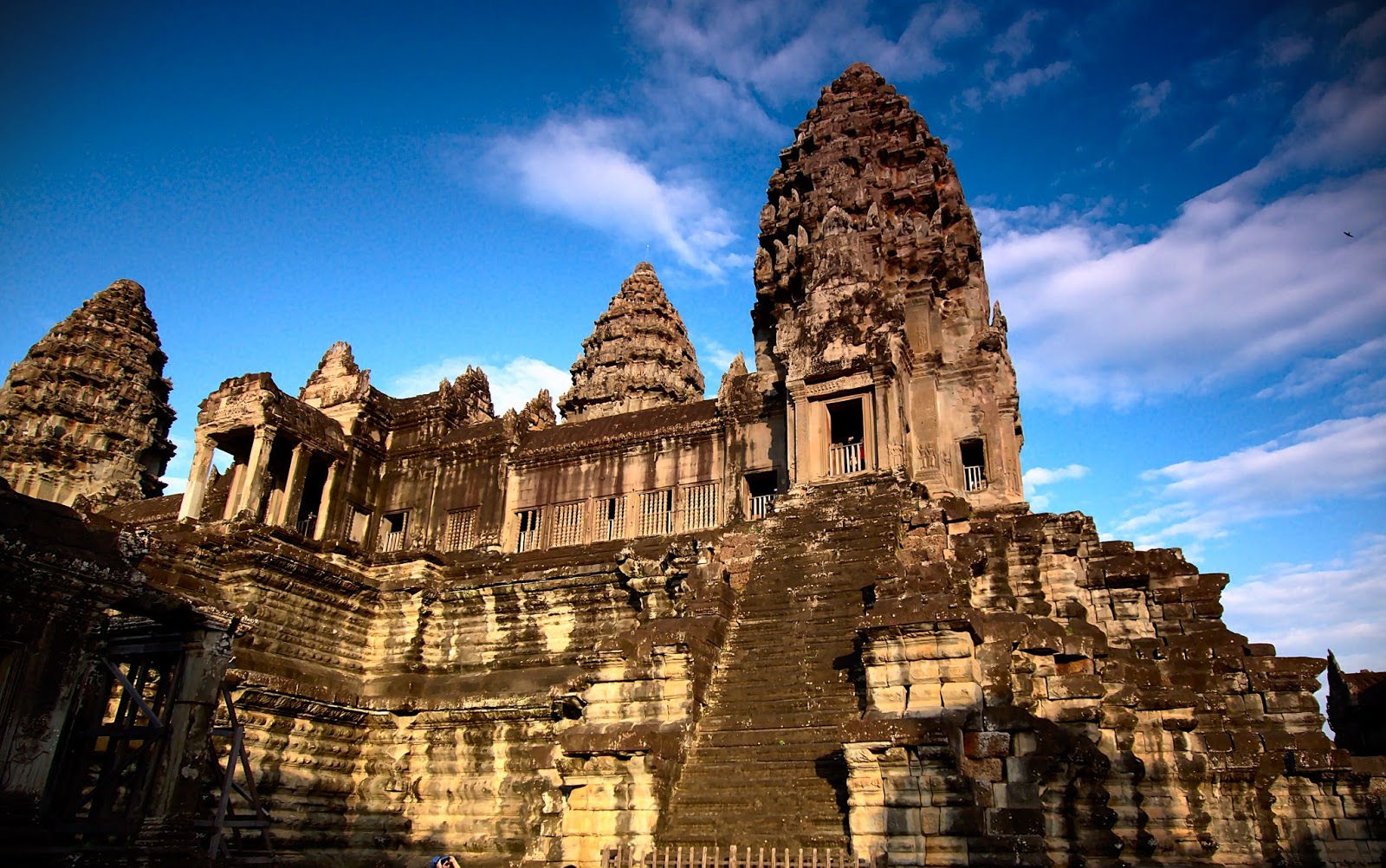
We then took the stairs directly ahead to reach the next level of the temple which opened into a large open courtyard and the view of the central gallery gleaming in the setting sun.
 |
|
The central gallery and three of the five towers |
The sun was at an angle and the main towers and the central gallery was nicely lit. We walked around to the east to join the queue to go up to the top gallery when we were told our younger daughter would not be allowed inside as she was under 12. So one of us had to stay behind and that happened to be me. I never got a chance to go up as they closed entry by 5 pm. One reason to make another trip!
 |
|
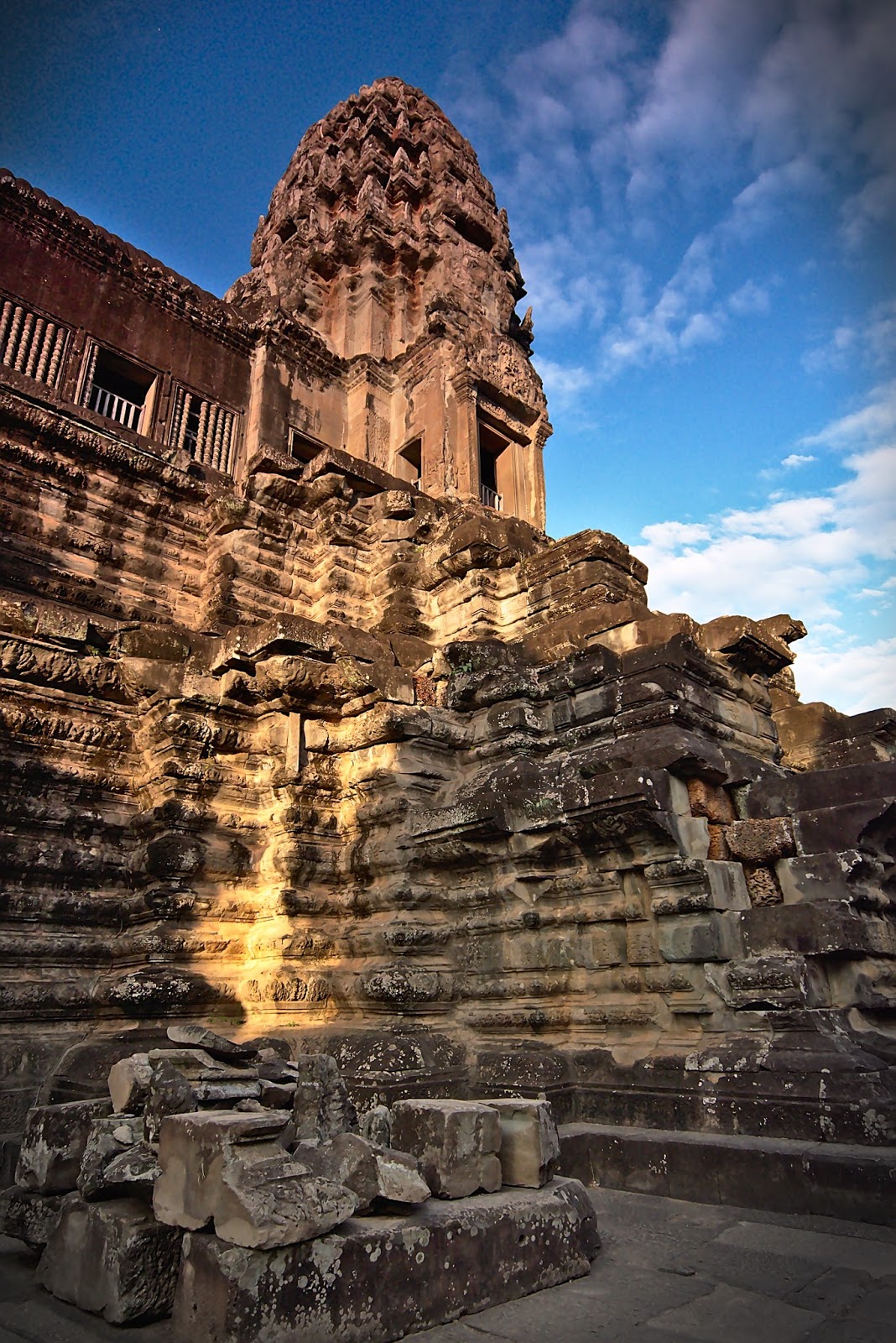
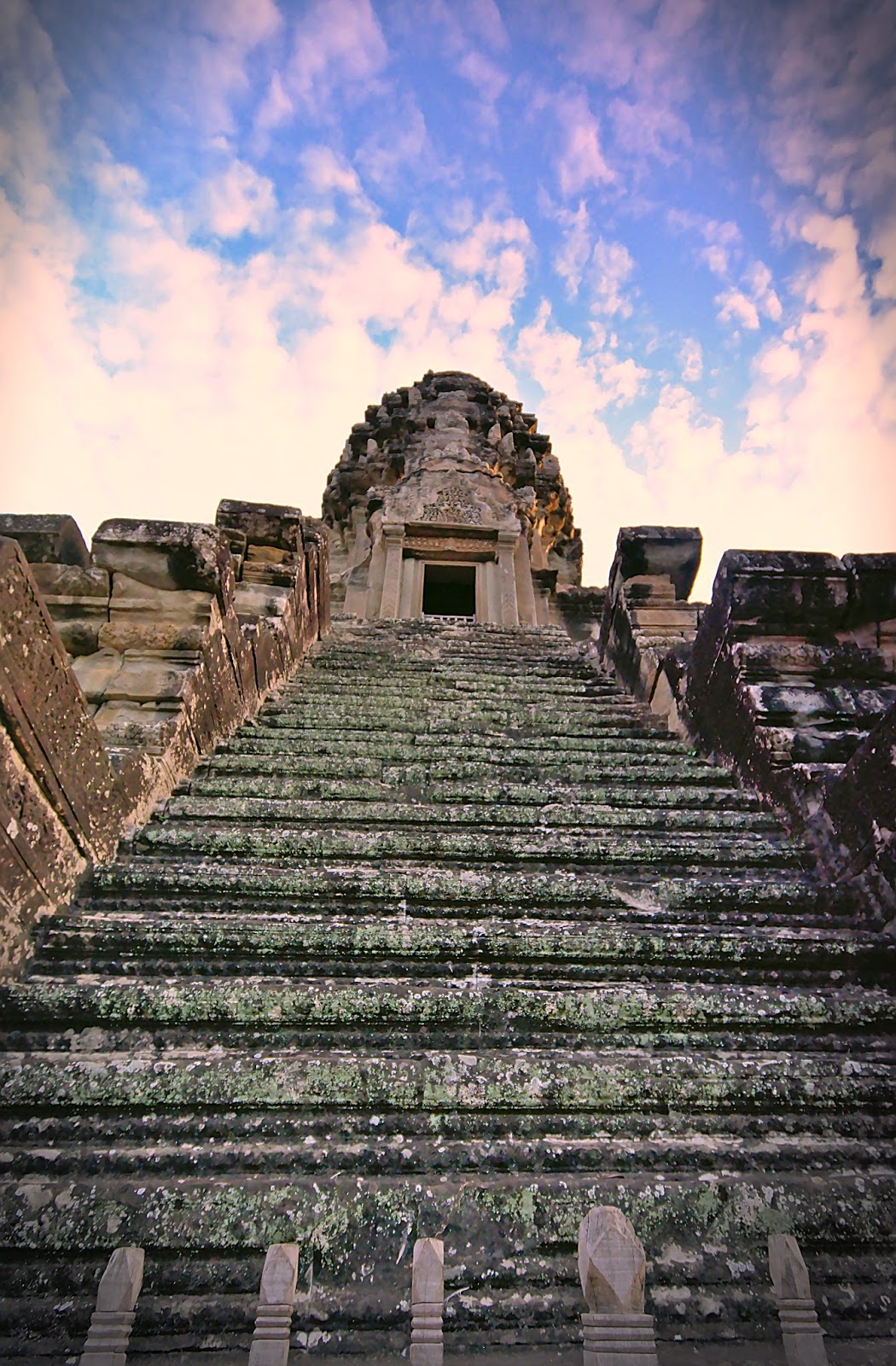
One of the corner towers, sanctuary and steps gleaming in the setting sun |
 |
|
The steep steps to one of the corner towers |
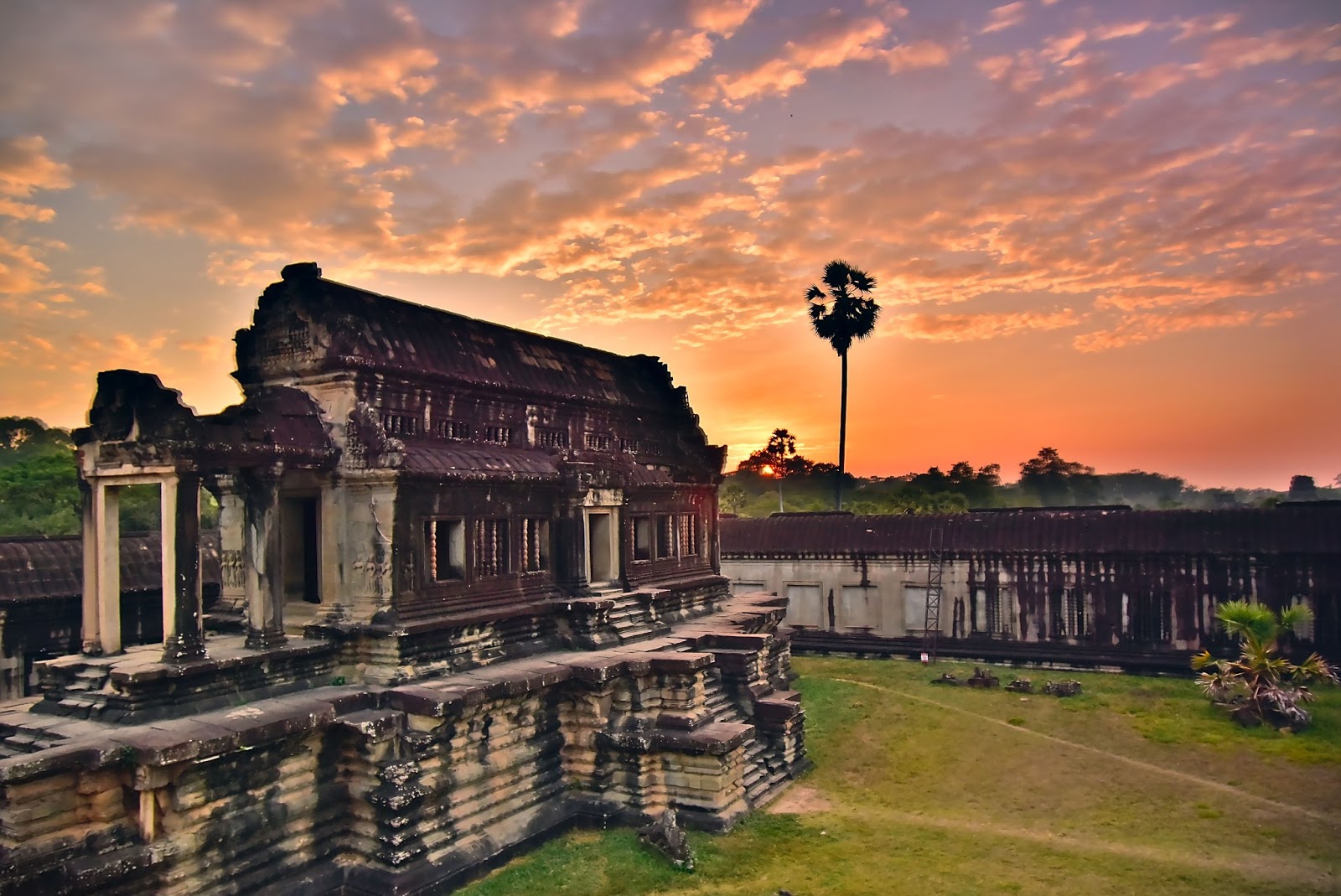
We made our way to the north-western gallery to watch the sun dipping below the horizon behind the library.
 |
|
Sunset from Angkor Wat |
It was pretty dark by this time and we carefully climbed back through the cloister to the entrance before we were hastened to leave by the Apsara personnel.
 |
|
Entrance Cloisters |
As we made our way out of Angkor Wat through the causeway and the moat we realised that we did not see the whole temple, especially the bas reliefs in the outer gallery. That’s 2 reasons to make another trip!
We were completely drained and tired with only a few hours of sleep the previous night. The only thing to look forward to that night was dinner at the Haven.
We reached our hotel on Taphul Street at about 6:30 pm and soon refreshed ourselves before taking a tuk tuk to Haven in Chocolate Road. I made reservations through email just a couple of days before and though I had it planned for the next evening I had to movie it up as they were full.
Dinner at Haven
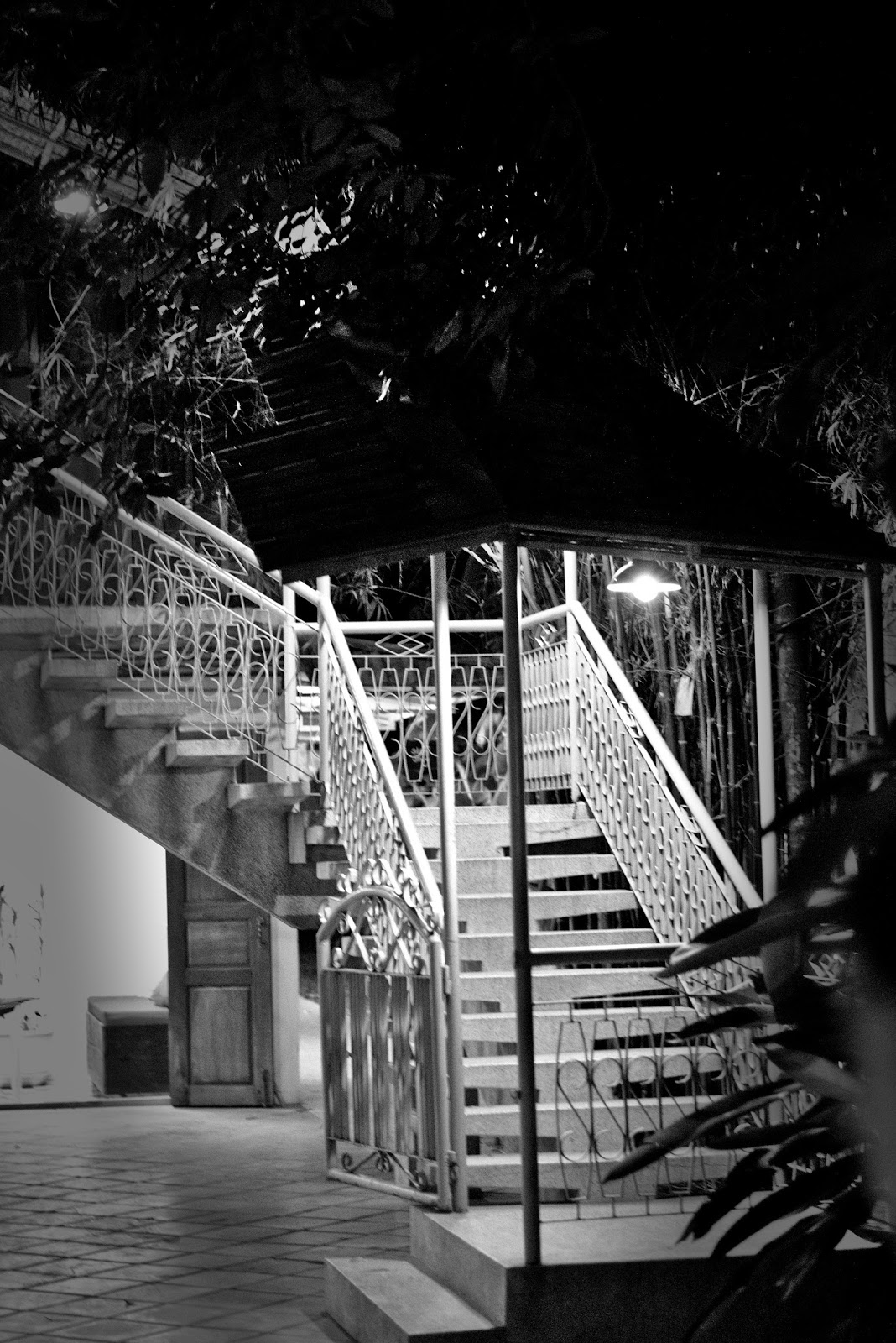
We were seated in the balcony as I had requested in my email and were presented with the menu by a charming Khmer girl. There were ample vegetarian choices and enough variety to please my rice-unfriendly girls! And of course we had to have coconut!
The food was absolutely delicious! The best food I ever had in Cambodia and I sure would have gone back the next night if they hadn’t been full!


After dinner we walked to Angkor Mini Mart to pick up some basics and I had to use offline Google Maps to direct the tuk tuk driver to our hotel!
Quite a long day, extremely well spent, we retired with a heart brimming with satisfaction and a body that was already supposed to be in deep sleep by it’s clock!
 |
|
Day 2 – Ta Prohm, Grand circuit and an evening in town >>> |
 Fly ✧ Ride ✧ Drive
One thought on “Angkor, Cambodia – Day 1”